— Research areas
My research, conducted with colleagues from the EM2C laboratory, focuses on three main areas:
- First, we develop complex kinetic models, called collisional-radiative (CR) models, that predict non-Boltzmann distributions of quantum states in nonequilibrium plasmas. Such nonequilibrium occurs in plasmas experiencing rapid changes in temperature and pressure or affected by radiation at low pressure. We validate these models against calibrated experimental data obtained from optical emission spectroscopy (OES) diagnostics.
- Second, we build detailed line-by-line (LBL) radiation models and validate them against calibrated experimental data. We also design reduced-order models, such as statistical narrow-band (SNB) models, to enable their integration into multiphysics computational fluid dynamics (CFD) simulations. Both LBL and SNB models target local thermodynamic equilibrium (LTE) and non-local thermodynamic equilibrium (NLTE) gases.
- Third, we work on reduced-order hydrodynamics models to simulate the effects of nanosecond discharges, including blast waves and shock-induced vorticity.
— Engineering applications
Here are three engineering applications targeted by our research:
- Atmospheric Entry: Spacecraft entering planetary atmospheres experience extreme radiative heat loads, whose strength is proportional to the internal distribution of quantum states. We use CR models to predict this distribution in strongly non-Boltzmann environments, such as the wake of a vehicle returning from the Moon or Mars.

Photo: “Atmospheric Reentry from ISS” — Wikimedia Commons. Video: “Orion: Trial By Fire” — NASA (Artemis I Orion re-entry). Public domain per NASA Media Usage Guidelines; embedded via YouTube. - Plasma Discharges: Nanosecond Repetitively Pulsed (NRP) discharges represent a promising technology for increasing combustion efficiency or electrifying industrial processes. We investigate their chemical and hydrodynamic effects and develop reduced-order engineering models. This work could also apply to other plasma applications, such as plasma nitriding.
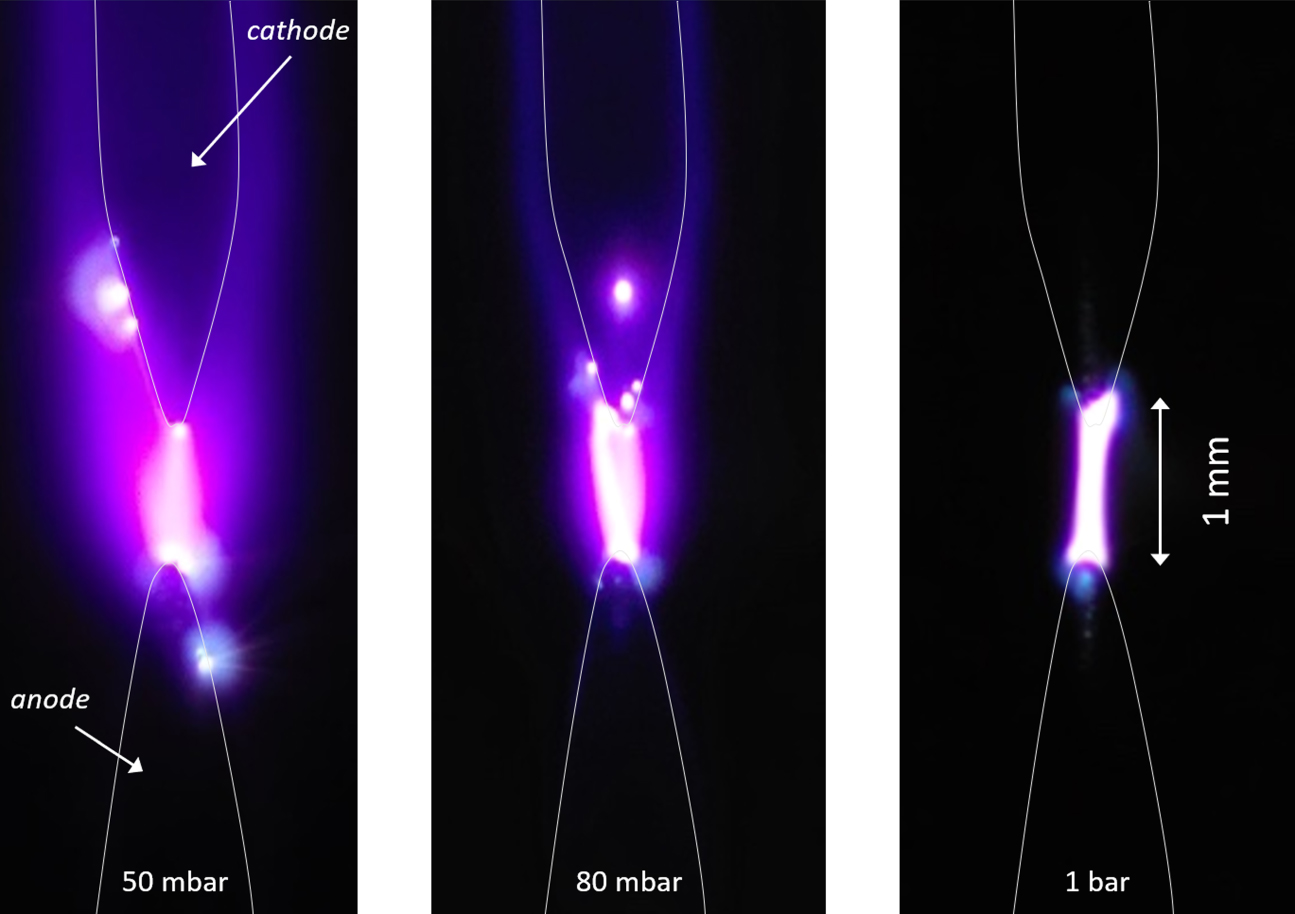
Photographs of single ns-discharges in real colors at 50 mbar, 80 mbar and 1 bar. Figure 4.3 from Minesi's PhD thesis (Université Paris-Saclay; 2020). 
Photo: “Plasma Nitriding Equipment” — Wikimedia Commons. - Rocket Exhaust Plumes: We employ LBL and SNB models to simulate the infrared radiation emitted by rocket exhaust plumes at the nozzle exit or at very high altitude.

Photo: “Rocket Lab PREFIRE and Ice Launch” — Wikimedia Commons. 
Photo: “Starlink Falcon Heavy launch in the sky” — Brandon Ghany / Horizon Productions SFL (SpaceX Starlink launch plume at twilight). Released under the CC0 1.0 Public Domain Dedication via Wikimedia Commons.
.jpg)

.jpg)
